


开放课题基金优秀成果系列专题(第六期)| 柳州市工人医院周益装研究员团队:新型培养基高密度发酵副干酪乳杆菌GY-1制备免疫胞外多糖
新型培养基中高密度培养副干酪乳杆菌GY-1产生一种结构独特的免疫刺激性胞外多糖
High-density cultivation of Lacticaseibacillus paracasei GY-1 in a novel medium produces a structurally distinct immunostimulatory exopolysaccharide
英文文献解读
▪期刊名称:International Journal of Biological Macromolecules(IF=8.7)
▪发表时间:2026年7月20日
▪通讯作者:周益装
▪单位:柳州市工人医院(广西医科大学第四附属医院)临床科学研究中心、桂林医科大学公共卫生学院、邵阳市第二人民医院检验医学科、广西长寿科技重点实验室、广西爱生生命科技有限公司、广西科学院生物科学与技术研究所
▪研究支持:本研究获得2024年广西长寿科技重点实验室开放课题基金资助(课题编号:gxkllst-20241007)。
▪原文链接:https://doi.org/10.1016/j.ijbiomac.2026.153612

研究背景
乳酸菌(LAB)是重要的益生菌,亦是高价值游离型胞外多糖(r‑EPS)的生产者。经典的分批培养因其操作简单、可行性强、易于并行化、无营养浪费和设备投入低等优点而广受青睐。然而,现行分批培养策略难以实现乳酸菌的高密度发酵,且r-EPS产量偏低,严重制约了其在益生菌及r-EPS相关产业中的应用。在分批培养模式下,所有必需营养物质均在培养初期一次性供给,而抑制性代谢产物在整个培养过程中不会被移除。因此,理想的高细胞密度培养(HCDC)培养基应在富含必需营养成分的同时,避免或尽量减少可生成有害代谢副产物的底物。如何开发符合这一要求的HCDC培养基,已成为该领域亟待突破的关键技术瓶颈。
针对上述问题,该课题组从培养基创新角度出发,以成本低廉的钝顶螺旋藻(SP)作为核心原料,采用15.48 g/L SP水解物完全替代传统MRS培养基中的所有氮源组分(包括蛋白胨、牛肉浸粉和酵母浸粉),并额外添加0.5 g/L玉米浆和1 g/L海藻糖,成功研发了一款新型多功能液体培养基(命名为MSP),用于副干酪乳杆菌(Lacticaseibacillus paracasei)GY-1的高效培养。
研究结果
实验结果表明,在MSP培养基中培养20 h后,GY-1菌株活菌浓度可达1.72×10¹¹CFU/mL,较传统MRS培养基提升70.07倍;r-EPS总产量达2686.23±17.56 mg/L,是MRS组的4.16倍,优于目前已报道的绝大多数乳酸菌胞外多糖合成水平。进一步分析发现,MSP体系下单株活菌多糖合成能力(0.16±0.01 mg/10⁷ CFU)低于MRS体系,表明多糖总产量的大幅提升源于菌体的高密度增殖,而非单一菌株合成能力提升。
对r-EPS的分离纯化获得两个主要组分——r-EPS1和r-EPS2,二者在MRS培养体系及MSP空白培养基中均未检出,为MSP培养体系特异性合成产物。体外活性实验表明,r-EPS1、r-EPS2均无细胞毒性,且均可有效促进巨噬细胞RAW264.7增殖,其中r-EPS2的促增殖效果显著优于r-EPS1与脂多糖LPS阳性对照组。细胞因子ELISA检测结果显示,两种多糖的免疫调控模式存在显著差异:r-EPS1仅诱导促炎因子(IL-1β、TNF-α、IL-6)分泌,发挥单向免疫调节作用,而r-EPS2可剂量依赖性同步上调促炎因子与抗炎因子(IL-10)表达,具备双向免疫调控能力。
结构表征显示,r-EPS2是一种新型多糖,分子量为7.66×10⁵ Da,单糖组成以葡萄糖为主(98.90%),含少量葡糖醛酸(0.61%)与甘露糖(0.49%),其分子主链为(1→4)-α-D-Glcp,支链为(1→4,6)-α-D-Glcp和(1→3,4)-α-D-Glcp。
综上,MSP是目前首个可在简单分批培养模式下,同步实现乳酸菌高密度和r-EPS高产量培养,且可特异性诱导合成结构独特、强效免疫刺激活性的r-EPS的多功能低成本培养基,在益生菌规模化培养、活性多糖产业化开发领域具备极高的应用潜力。
图例说明
1 基于单因素实验的MSP培养基开发
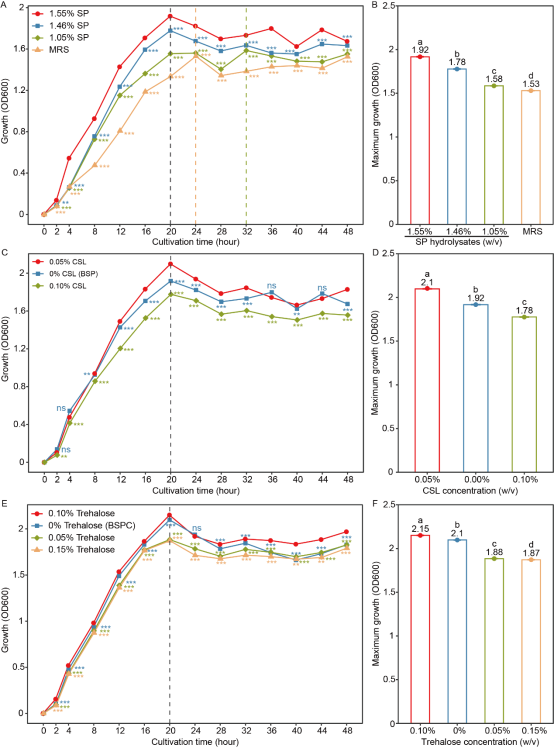
Fig. 1. Development of MSP through single-factor optimization of Spirulina platensis (SP) hydrolysates, corn steep liquor (CSL), and trehalose concentrations. Growth curves (A) and maximum growth at 20 h (B) under different concentrations of SP hydrolysates, with dashed lines indicating peak growth time points (gray line: 1.46% and 1.55% SP groups; other lines: respective media). Growth profiles (C) and corresponding maximum growth (D) with different CSL concentrations (dashed line: peak growth time). Growth patterns (E) and corresponding maximum growth (F) with varying trehalose concentrations (dashed line: peak growth time). Points and error bars represent the mean ± SD (n = 3); the number above each error bar represents the average of three measurements; **P < 0.01, ***P < 0.001, and ns, P > 0.05, t-test compared with the optimal concentration group at the same cultivation time; different lowercase letters indicate statistical differences at P < 0.05, one-way ANOVA followed by Tukey’s post hoc test.
2 MSP相较于MRS的优异生长性能
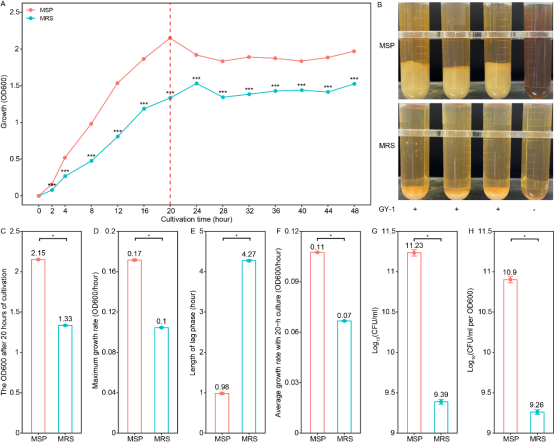
Fig. 2. Remarkable growth performance of MSP compared to MRS. (A) growth curves; (B) tube photographs of 20-h cultivation; (C) maximum growth (OD600) after 20 h of cultivation; (D) the maximum instantaneous growth rate represented by the steepest slope; (E) length of lag phase; (F) average growth rate over a 20-h culture period; (G) quantity of viable cells cultivated at 20 h; (H) number of viable cells per OD600 cultivated at 20 h. Points and error bars represent the mean ± SD (n = 3); the number above each error bar represents the average of three measurements; ***P < 0.001 in panel A, t-test compared with MSP; *P < 0.05 in panels C-H, Wilcoxon rank-sum test with continuity correction; dashed vertical line, the time to reach peak growth by MSP.
3 MSP相较于MRS的r‑EPS总产量提高
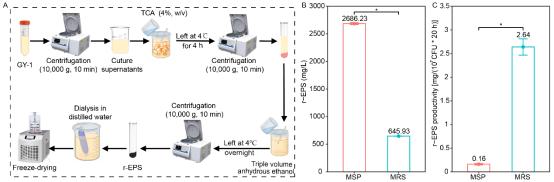
Fig. 3. Comparison of r-EPS yields between MSP and MRS cultivation. The diagram of extraction of r-EPS (A) as well as the production (dry weight) and productivity of r-EPS (B, C). Points and error bars represent the mean ± SD (n = 3); the number above each error bar represents the average of three measurements; *P <0.05, Wilcoxon rank-sum test with continuity correction.
4 MSP中特异性生物合成的r‑EPS1和r‑EPS2的纯化与鉴定
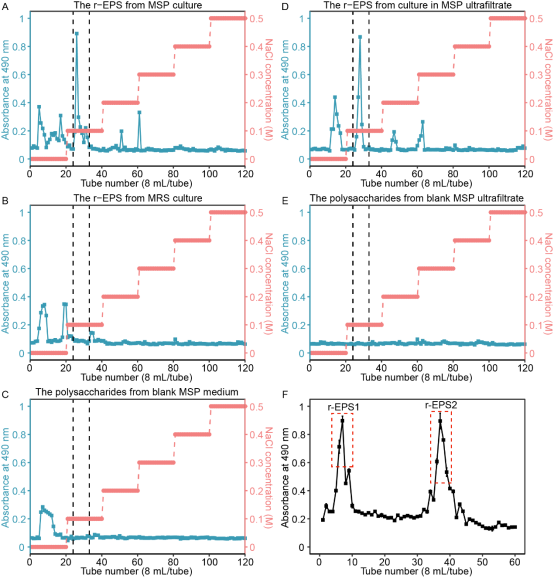
Fig. 4. Purification and identification of r-EPS specifically produced in MSP broth. Elution curves of r-EPS from MSP culture (A), r-EPS from MRS culture (B), polysaccharides from blank MSP broth (C), r-EPS from culture grown in MSP ultrafiltrate (D), and polysaccharides from blank MSP ultrafiltrate (E) on DEAE cellulose-52 columns; elution curve of the fractions corresponding to the prominent peak (indicated by the two dashed lines in panel A) on Sephadex G-100 columns (F). Data are presented as the mean ± SD (n = 3). The fractions between the two vertical dashed lines indicate that the r-EPS are biosynthesized in MSP, not in MRS, and do not originate from the MSP medium.
5 r‑EPS1与r‑EPS2的免疫刺激活性比较
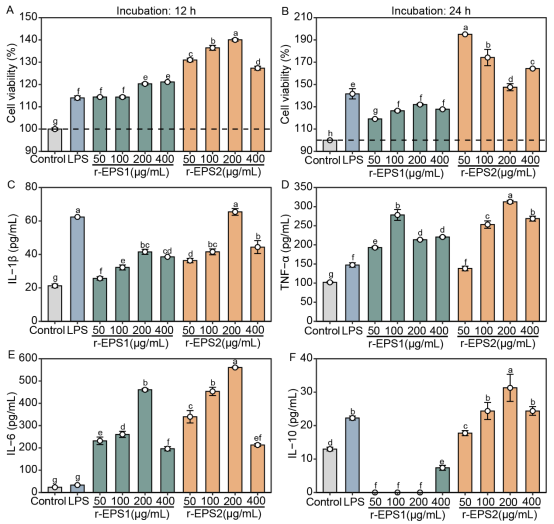
Fig. 5. Cytotoxicity and immunostimulatory activity of r-EPS1 and r-EPS2 in vitro. (A) cell viability of RAW264.7 macrophages at 12 h; (B) cell viability of RAW264.7 macrophages at 24 h; (C–F) effects of r-EPS1 and r-EPS2 on the secretion of IL-1β, TNF-α, IL-6, and IL-10 by RAW264.7 macrophages after 24-h treatment. Points and error bars represent the mean ± SD (n = 6); the white dot represents the mean of six biological replicates; different lowercase letters indicate statistical differences at P <0.05, one-way ANOVA followed by Tukey’s post hoc test.
6 r‑EPS2的理化特性
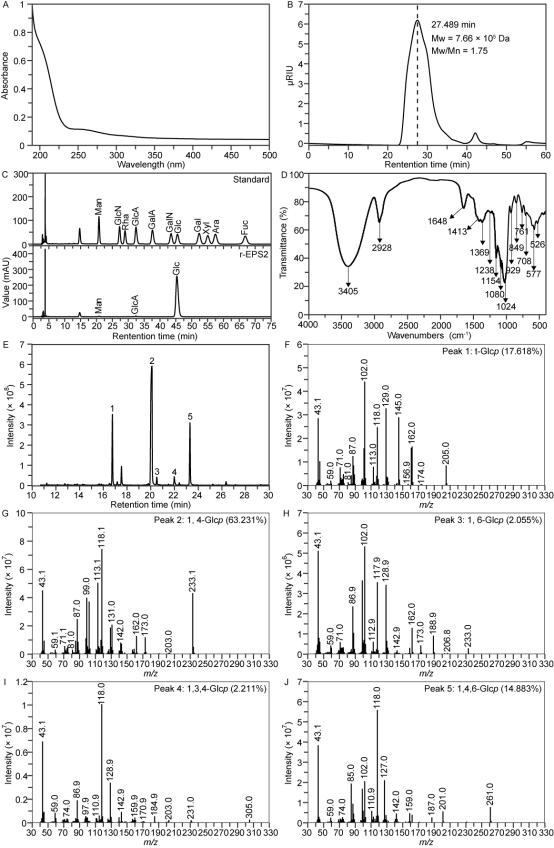
Fig. 6. Physicochemical characteristics of r-EPS2. (A) UV–vis spectrogram; (B) elution profile of r-EPS2 obtained through HPGPC; (C) monosaccharide composition of r-EPS2 determined by HPLC; (D) FT-IR spectral analysis of r-EPS2; (E) GC-MS total ion chromatogram of r-EPS2 methylation; (F-J) the MS spectra of the methylated mass fragments of r-EPS2. Man, mannose; GlcN, D-glucosamine hydrochloride; Rha, rhamnose; GlcA, glucuronic acid; GalA, galacturonic acid; GalN, D-galactosamine hydrochloride; Glc, glucose; Gal, galactose; Xyl, xylose; Ara, arabinose; and Fuc, fucose.
7 r‑EPS2的结构表征

Fig. 7. NMR spectra and proposed structure of r-EPS2. (A) 1H; (B) 13C; (C) HSQC; (D) COSY; (E) HMBC; (F) NOESY; (G) the putative structure of r-EPS2.
结论
总之,本研究开发了一种新型且成本低廉的MSP培养基,该培养基可在分批模式下实现GY-1的高细胞密度培养(HCDC),同时提高游离型胞外多糖(r-EPS)的总产量。对r-EPS的分离纯化获得两个主要组分——r-EPS1和r-EPS2,它们均是在MSP中特异性产生。体外实验表明,r-EPS2的免疫刺激活性显著强于r-EPS1和脂多糖(LPS)。结构表征揭示r-EPS2具有独特的分子结构。据我们所知,MSP是首个能够在乳酸菌中同时实现HCDC、总r-EPS产量提高并特异性产生结构独特且生物活性增强的r-EPS的多功能培养基。这些发现凸显了设计兼具益生菌和EPS应用价值的多功能培养基的可行性。此外,本工作表明,通过创新生长培养基,这些优势可在简单的分批培养中实现,从而强调了培养基优化在乳酸菌研究中的关键作用。
基金支持与研究意义
本研究获得2024年广西长寿科技重点实验室开放课题基金资助,课题紧扣重点实验室长寿健康资源挖掘与功能性益生菌开发的核心研究方向,聚焦益生菌低成本高效培养体系构建与新型免疫活性多糖的发掘研究。研究成果极大丰富了乳酸菌胞外多糖的结构与功能研究体系,突破传统体系的技术短板,开发的MSP培养基成本低廉、操作简便、适配工业化分批生产,可广泛推广应用于干酪乳杆菌、鼠李糖乳杆菌、发酵乳酸杆菌等多种类型乳酸菌的培养与功能代谢研究,为重点实验室开展长寿相关功能性益生菌资源深度挖掘、高活性免疫调节物质的筛选及产业化转化提供了坚实的实验依据与全新技术思路,有效推动大健康领域功能性食品、免疫调节剂的研发及落地应用,兼具重要的基础科学研究价值与广阔的产业应用前景,为长寿科技产业化、规模化发展提供有力的技术支撑。
